
Yesterday I got the question for the first time: We aren’t going to do anything today, are we?
The question gave me a good laugh. It was Tuesday morning and the break the student referenced as a reason to kick back and do nothing didn’t start until Friday afternoon.
Even still, I think the question speaks for a lot of us this time of year. I always forget how tired they are, how tired I am, after 17 demanding weeks. As the student said it, truth be told, I could feel the break—still four days away—nudging at my mind too.
This is all to say, that a few weeks ago when I was at NCTE and envisioning the deep-dive into feedback for this month, I once again discounted how one of my feet (and maybe half of another) would be already walking to the door for break at this point, and I don’t believe I’m alone in those feelings.
So I’ve decided to hold off on the rest of the feedback posts until after the New Year, when my newly break-freshened mind (and maybe yours as well) will be in a better state to dive deeply into such things.
Instead I thought I would offer two things before signing off for the break. The first is to say thank you for your trust. Teacher time is one of the most valuable resources anywhere, and I deeply appreciate you entrusting some of it with me.
The second is to share my favorite pre-break lesson. Planning for the lessons leading up to a break is notoriously tricky. Many of the students are, as I’ve discussed, already in break mode, and there are usually quite a few students actually absent as well. At the same time, I’m not comfortable with just doing nothing, especially because strong work going into break often predicts strong work coming out of it.
With these factors in mind, I’ve experimented over the years with various approaches to pre-break lessons that are quietly (shhh) meaningful and at the same time honor (or at least accept) how worn down students are, and their need to do, if not nothing, something different. In particular, I’ve come to really enjoy the lesson shared below. I’ve found its theatricality, activity, collaboration, and creativity largely satisfies students’ need for something fun and different, while at the same time the game quietly reinforces key information from the semester through retrieval practice and collaborative creativity. Think about it as my gift to you as a thank you for your readership.
My Favorite Pre-Break Lesson
- The game is called the Royal Rumble, which is a nod to the silly “professional” wrestling matches of my childhood. I call it that specifically because it allows me to dramatically use the “Let’s Get Ready to Rumble” sound/video clip to kick class off. I don’t think one necessarily has to have this theme or play that sound clip, but I do feel that something silly, mock-dramatic, or otherwise different is key to kicking off the class and quieting the “Are we doing anything?” voice that will be screaming in many students’ heads by the day before break. I also often wear a mock bowtie to add to the vibe.
- Once the game is established, assemble the students into teams and tell them that they are playing for candy/cookies/anything else that feels fun. You don’t necessarily have to do this either, but I find playing for something sweet (usually I have enough for everyone and extra for the winning team) adds to the party-ish atmosphere of the day.
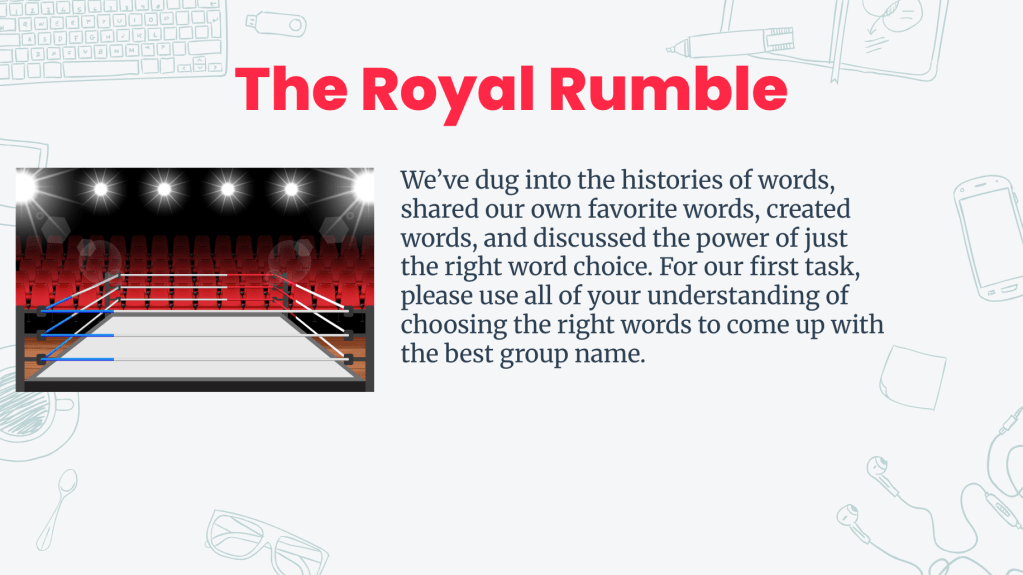
- Then have a series of rounds where the students play games that ask them to retrieve and use key concepts in groups to accomplish some task. For example, we revisit our lesson on word choice before they do the first round (see image below), which is to give their team the best-worded name.
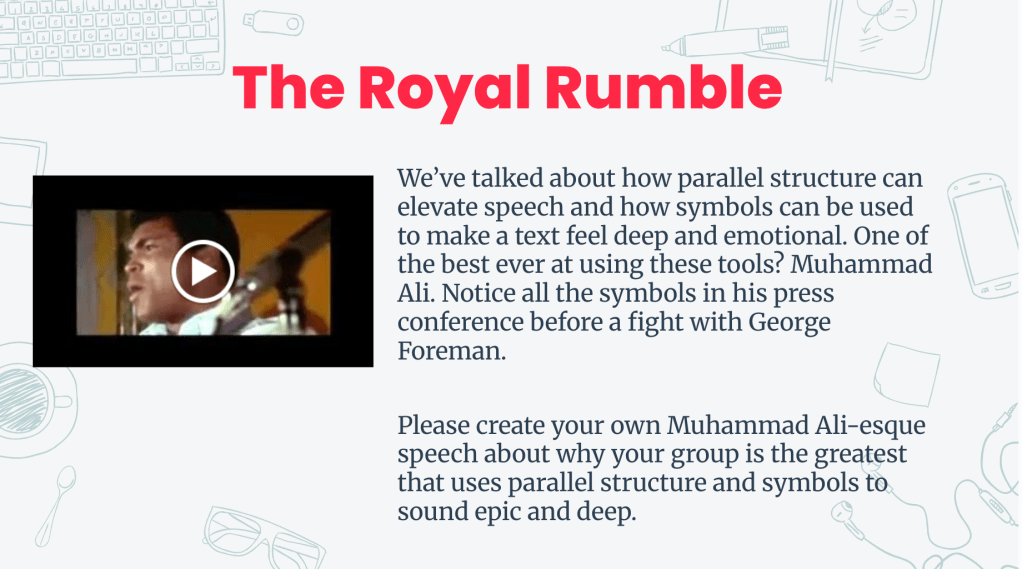
Another example is that we revisit parallel structure and symbolism before they create mini-speeches about why their team is the greatest a la the style of linguistic/boxing mastermind Muhammad Ali (I do make an announcement about keeping this positive and focused on their greatness and not disparaging other teams).
During each round I grant points and quietly reinforce key lessons, all in the persona of a play-by-play announcer.
- At the end, the final round is simple: The class reviews all the key lessons from the semester about writing (we make a big list) and then each group has to jointly write something that wows me. Once all groups have gone, we add up the points, crown a winner, hand out sweets, and take a few minutes to enjoy each other’s company and discuss break plans.
I’ve had great luck with this lesson over the years for doing the valuable task of reinforcing lessons before an extended break while also having fun together. Here are the slides from my most-recent version of it. I think it could be adapted any number of ways, but I hope it is of use for you and that you have a wonderful and restful break.
Thanks, as always for reading, and see you early in 2026 to finish talking about providing better, faster feedback in the New Year!
Yours in teaching,
Matt
If you liked this…
Join my mailing list and you will receive a thoughtful post about finding balance and success as a writing teacher each week along with exciting subscriber-only content. Also, as an additional thank you for signing up, you will also receive a short ebook on how to cut feedback time without cutting feedback quality that is adapted from my book Flash Feedback: Responding to Student Writing Better and Faster – Without Burning Out from Corwin Literacy.
 Matthew M. Johnson
Leave a comment