Looking to Upgrade Your Grammar and Language Lessons This Year? Meet Good Grammar!

It is still hard for me to believe, but after nearly four years of writing and editing, Good Grammar: Joyful and Affirming Language Lessons That Work for More Students is officially out!
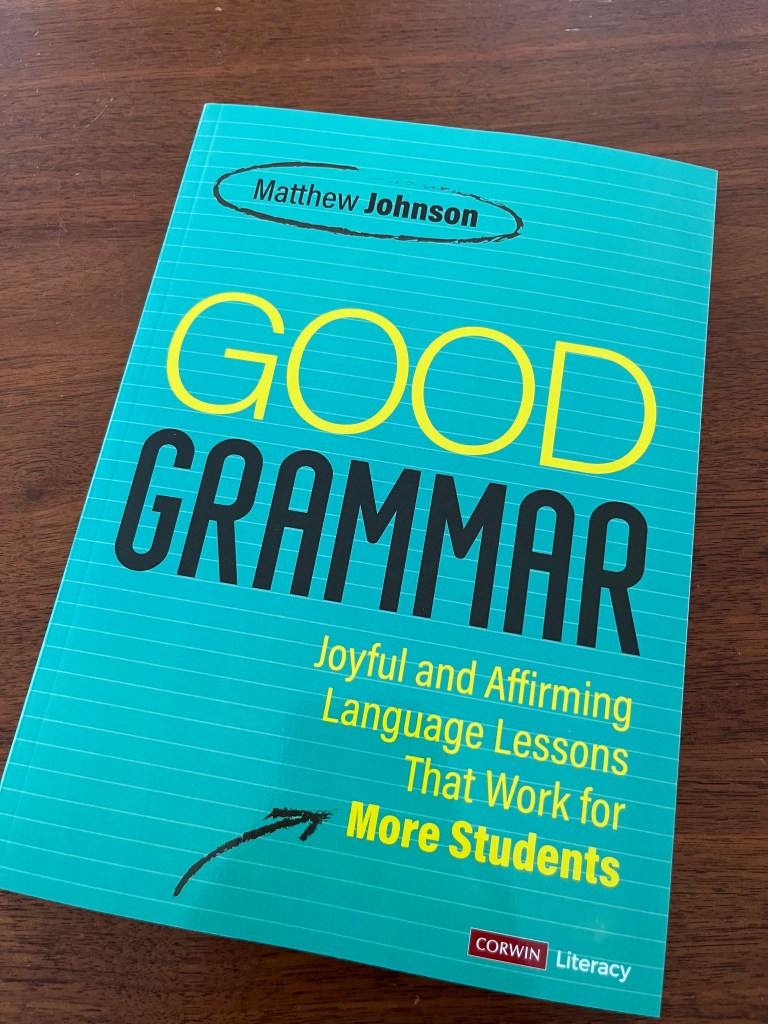
A close-up view of the book titled 'Good Grammar' by Matthew Johnson, featuring a bright turquoise cover with bold yellow and black lettering, placed on a wooden surface.
My book Good Grammar

I’ve talked about it here before, so I won’t spend too much time explaining it. But in short, here is what it is about:

For so many years, so many of my lessons concerning grammar and language fell flat. Really flat. I would try to dress them up with creative prompts or figure out silly activities (one year I even hosted my own Grammar Battle with other classes complete with prizes), and yet no matter what I did, it was clear that most of my students found discussion of grammar and language to be dull, disconnected, and not particularly useful. At times students even got upset or defensive because they didn’t like how many standard grammatical lessons framed their communication as being incorrect or not enough in some sort of way. 

It got so bad that for a meaningful chunk of my career I did what I’ve come to learn that many ELA teachers do: I stopped doing grammar and language instruction all together. 

Jump forward to today, and Good Grammar got its title from the role that grammar and language study now plays in my classroom. It is truly a force for good and is hands-down my students’ favorite part of class each year. I think what they like most about it is that the lessons help them to understand how language works, and that in turn allows them to more accurately bring their voices to the page. 

As the subtitle suggests, my approach is also one grounded in joy, affirmation, and celebration of the knowledge students already bring with them. Each student comes in on the first day with a beautiful, fully-formed idiolect that weaves together linguistic threads of the most beloved people and places in their lives, and discussions of such things should, in my opinion, be joyful, affirmative, and celebratory affairs.

My hope is that Good Grammar helps you to make grammar and language a good (or even better) part of your classroom as well. For those who want to learn more, here is the book’s introduction and here was my introduction on this newsletter.

And for those who want to get it, the best price is still on Corwin‘s site with the code RAVEN25, which gives readers of this newsletter (and anyone they share it with) 25% off and free shipping. Also, if you are willing to take a few moments to leave a review on Amazon/Goodreads to let others know about it, I would be deeply appreciative.

I’ll be back with a post to kick off the school year early next week, and until then thanks for taking the time to read about Good Grammar on its official birthday, and I hope those who are already back in the classroom this week are having a great start!

Yours in teaching,
Matt

5 responses to “Looking to Upgrade Your Grammar and Language Lessons This Year? Meet Good Grammar!”

  1. This sounds really great, but the Corwin website does not have a sample lesson/activity to look at so it’s hard to know whether or not it would be appropriate for my context and students (secondary, international school). Is there any possibility of seeing one? Amazon’s preview only has the introduction, table of contents, and index. My budget is super limited (in fact I’d be ordering it out of my own pocket) so I really can’t afford to order sight unseen. Just one activity/lesson would give me a good enough idea!

    Like

    1. Thank you so much for the kind words, and I’m happy to share one or more lessons from it. Here is one that Corwin packaged (I’m actually doing it tomorrow) where students explore their own language stories. If you need more though, let me know! https://us.corwin.com/docs/default-source/resources-documents/johnson_good-grammar_lesson-2.pdf?sfvrsn=8d85f405_3

      Like

  2. Catherine Lavin Avatar
    Catherine Lavin

    Hi- I purchased your book and have been reading through the lessons (very helpful and worthwhile). I was wondering if you could give a sense of how you structure your ELA classes- do you, for example, spend 1-2 weeks on your opening grammar set of lessons- then take a break to focus on other parts of your curriculum (like the essays of the week, etc..)- or do you spend one or two days a week on the grammar lessons and mix in the other parts…it’s the scheduling I always have a hard time with in my own classroom. Thank you.

    Like

    1. Hi, Catherine! That is a great question, and it comes at the intersection of two major and competing issues: The first is that if we use a disconnected mini-lesson approach to grammar/language, where we talk about the colon or comma one day and never speak of it again, the odds are that those lessons will be forgotten, as we are largely designed to forget things covered once and then never revisited. The other issue though is that we already never have enough time to cover it all, so adding more can be really tricky.

      I want to preface how I manage these competing issues by saying that I don’t think there is one way to structure grammar/language instruction. I’ve seen successful teachers who open up each day with a 10 minute grammar/language bell-ringer, those who have a day of the week where they do writing/language lessons, and those who have mini-units.

      I have tried all of those approaches, but what I do now is a sort of intersection of them. In my first unit of the year, I have a mini-unit where we discuss the students’ idiolects and voices. I do most of the lessons from chapter 1 in that unit to establish core concepts and what the grammar/language lessons will/won’t be. The rest of the year I then have Language Fridays, where I have a grammar/language lesson each Friday that lasts between 20 minutes and the whole hour and that goes through the lessons from the other four chapters (with each quarter covering one core concept, emphasizers, cadence, etc.). I also have taken to having students creating their own grammar/style manual where they record each Friday’s lesson. This helps keep me honest with doing retrieval practice and gives the students a tool they can use during revision and take with them to future years.

      Does that help? Again, I don’t think this is the one answer, but it is an answer that has worked well for my classes. I think the key is to make sure you have an organized way of revisiting, retrieving, and using and building upon the lessons that came before.

      Thanks for the question and for buying the book, and please reach out if there is anything else I can help with!!

      Like

      1. Catherine Lavin Avatar
        Catherine Lavin

        Thank you so much- this is really helpful. I was thinking that the whole opening unit ought to be covered right away altogether- and I like the idea of dedicating a particular day each week to the rest of the concepts- the lessons you have shared do seem better served to spending a whole or at least a significant portion of the class periods on. I look forward to trying them out with my 6th graders!

        Best,

        Catherine

        Like

Leave a comment