
It is still hard for me to believe, but after nearly four years of writing and editing, Good Grammar: Joyful and Affirming Language Lessons That Work for More Students is officially out!
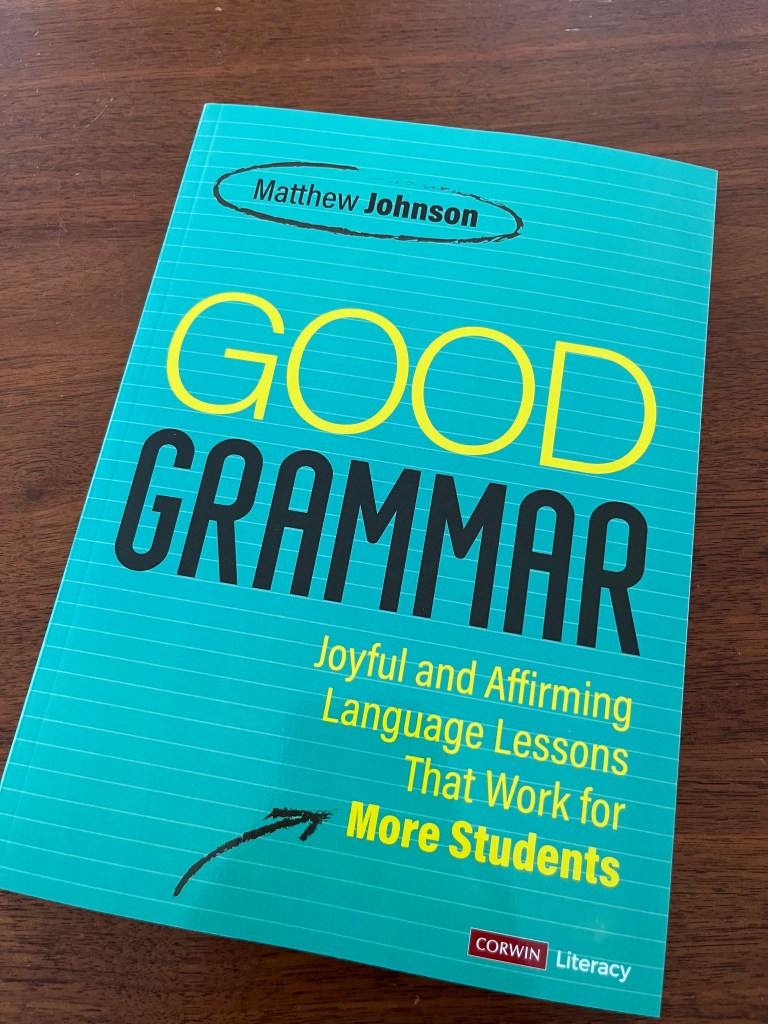
I’ve talked about it here before, so I won’t spend too much time explaining it. But in short, here is what it is about:
For so many years, so many of my lessons concerning grammar and language fell flat. Really flat. I would try to dress them up with creative prompts or figure out silly activities (one year I even hosted my own Grammar Battle with other classes complete with prizes), and yet no matter what I did, it was clear that most of my students found discussion of grammar and language to be dull, disconnected, and not particularly useful. At times students even got upset or defensive because they didn’t like how many standard grammatical lessons framed their communication as being incorrect or not enough in some sort of way.
It got so bad that for a meaningful chunk of my career I did what I’ve come to learn that many ELA teachers do: I stopped doing grammar and language instruction all together.
Jump forward to today, and Good Grammar got its title from the role that grammar and language study now plays in my classroom. It is truly a force for good and is hands-down my students’ favorite part of class each year. I think what they like most about it is that the lessons help them to understand how language works, and that in turn allows them to more accurately bring their voices to the page.
As the subtitle suggests, my approach is also one grounded in joy, affirmation, and celebration of the knowledge students already bring with them. Each student comes in on the first day with a beautiful, fully-formed idiolect that weaves together linguistic threads of the most beloved people and places in their lives, and discussions of such things should, in my opinion, be joyful, affirmative, and celebratory affairs.
My hope is that Good Grammar helps you to make grammar and language a good (or even better) part of your classroom as well. For those who want to learn more, here is the book’s introduction and here was my introduction on this newsletter.
And for those who want to get it, the best price is still on Corwin‘s site with the code RAVEN25, which gives readers of this newsletter (and anyone they share it with) 25% off and free shipping. Also, if you are willing to take a few moments to leave a review on Amazon/Goodreads to let others know about it, I would be deeply appreciative.
I’ll be back with a post to kick off the school year early next week, and until then thanks for taking the time to read about Good Grammar on its official birthday, and I hope those who are already back in the classroom this week are having a great start!
Yours in teaching,
Matt


 Matthew M. Johnson
Leave a reply to Catherine Lavin Cancel reply