
I have a rule that I tell students on the first week: If you don’t know why we are studying something, why we are studying something in the way we are, or why I’m assessing you in a certain way, please ask. I will always answer, and I will never answer (as I sometimes did early in my career) with Because I’m the Teacher…
This little speech is admittedly a bit theatrical, but theater can be useful to make a point, and I really want my students to hear an important message: What we do in here matters. It is important. It is not busywork. It is the work of being human, of learning about and from other humans. It is learning how to cultivate and share our own unique voices and perspectives with a world that really needs them.
It is pretty safe to assume that most teachers believe something similar about the importance of their content areas. They have devoted their working lives to passing the knowledge of their disciplines on to the next generation, after all. And yet despite this, the most common complaints I hear students chatting about as I walk down the hall or greet students at the door are about how pointless they find certain classes, assignments, or whole subject areas to be.
Complaints like these about the relevance and use of schoolwork are so common and longstanding that they have in many ways become a part of the cliche of the secondary student and are woven throughout popular culture. As such, it is easy not to think about about how odd it is that students often talk this way. A desire to learn about the world is build into adolescence, and teachers, as content enthusiasts, should be the perfect evangelists and instructors for their subjects. And yet so often something happens that leads students to not find utility, value, interest, or joy in some of their classes.
The geneses of these negative reactions are undoubtedly varied, but I’ve long suspected that one of the most common culprits might be that students have simply never been taught about the value of particular subjects, approaches, or assessments. One of the dangers of expertise is that it is easy to forget that others don’t know what you know, and so it makes sense that teachers might regularly overlook the fact that students might not see the value that teachers so readily see in the topics they cover or the approaches and assessments they use.
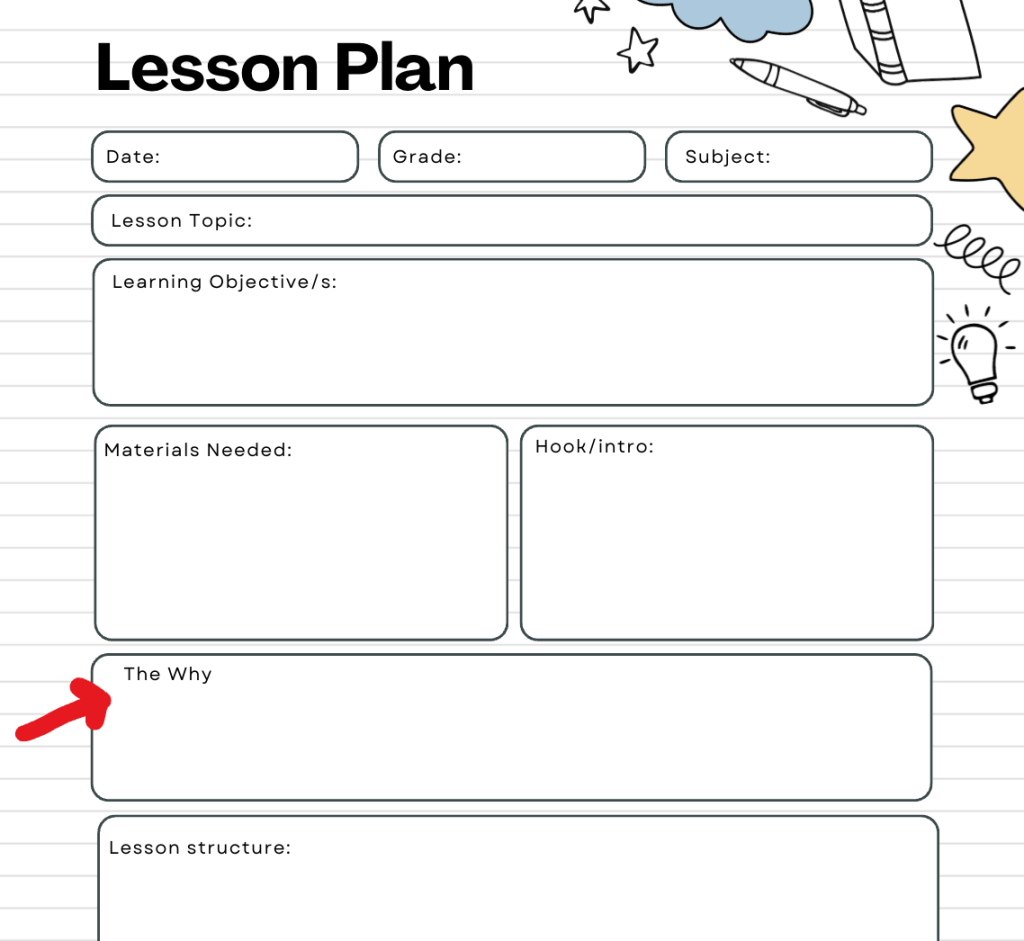
This suspicion led me to make a subtle but essential change to my lesson plan approach a few years ago. The classic teacher lesson plan revolves around student learning objectives—the knowledge or skills the students will walk away with.

This is as it should be, but a few years ago I decided to create another box on my lesson plans to accompany student learning objectives: The Why. The notion was that alongside identifying the learning objectives, I would take a few minutes to identify the the value of those objectives and my approach to them. I would then build this Why into my lessons as prominently as the student learning objectives that are posted on my board each day.
How I bring in the Why depends on the lesson. Sometimes, I am direct. When we learn about dashes and colons, I tell them that, yes, they are worth knowing because the SAT and ACT almost always have a dash/colon question or two, but I also go further and give a more expansive why. I tell them that dashes and colons are relatively new linguistic inventions created to mimic how we pause when we talk (not unlike how emojis mimic our expressions), allowing our voices to be better heard. I also talk about how they can differentiate us from AI or seed AI suspicions, depending on how they are used.
Other times the Why comes through discussions with the students. Before we write our first essay, I ask them, “Why do you think essay writing is such a big part of English language arts class?” Before our first big class discussion, I ask them why we have class discussions and what the answer means for how we should approach them.

Most often though, the why comes through a combination of discussion and direct instruction. Before we set up our independent reading for the year, I ask them, “Why do you think it is important to do independent reading alongside the assigned reading for class?” As a class we then make a list, and I then supplement that list with five other reasons why independent reading can have a profoundly positive impact on their lives (more on those next week).
I’ve shared this before, but a useful shorthand for motivation is the Expectancy-Value Theory, which argues that our motivation in many situations can be boiled down to two simple questions that we ask ourselves about each new pursuit:
- Can I do this?
- Is it valuable?
If the answer to both is a resounding yes, we tend to have motivation and engagement. If the answer to either or both is no or maybe, we don’t.
Much of the work of this newsletter explores how we can help students to feel better prepared to do the hard, beautiful work of reading, writing, arguing, listening, and thinking. But no matter how well we do that, if they don’t understand the Why, we are in potential trouble. This trouble is especially pronounced in this moment; a recent large study found that 70% of students said that they believe the skills they are learning in school will soon be able to be done by Gen AI. And so now, more than ever, it might be worth putting a spotlight on the Why to make sure students see our content for what it really is: Something so essential that we teachers spend the majority of our days thinking about how to better pass the gift of it on to our students.
Thanks for reading, and yours in teaching,
Matt
If you liked this…
Join my mailing list and you will receive a thoughtful post about finding balance and success as a writing teacher each week along with exciting subscriber-only content. Also, as an additional thank you for signing up, you will also receive a short ebook on how to cut feedback time without cutting feedback quality that is adapted from my book Flash Feedback: Responding to Student Writing Better and Faster – Without Burning Out from Corwin Literacy.


 Matthew M. Johnson
Leave a reply to Understanding the ‘Why’… | BeAsBuilt Cancel reply