
I remember sitting down to read a student paper last year and instantly feeling the beginnings of that whispered question that many teachers have come to know so well:
Hmm, I wonder if this was written by AI?
Sadly, this was not a novel experience for me, but what made this experience different was that it got me thinking about a second, more existential question:
What does it mean to live in a world where everything we write from now on comes with a whispered question of AI authorship hovering over it like a digital spectre?
Because everything—everything—that our students (and we) write from this point on will likely come with some version of that question. And while much of the research on AI writing is murky, it is already quite clear that when we view writing as being a product of AI, not a person, it becomes instantly less credible, interesting, and engaging (see below).
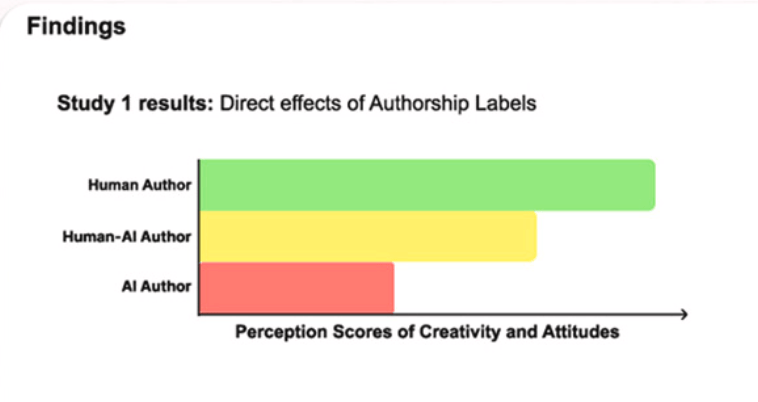
These results make a lot of sense too because, regardless of what some Gen AI companies insinuate, reading isn’t just an act of receiving information. It is a moment of connection with the brain of another human—a fellow traveler who comes with a unique perspective and set of lived experiences.
There is something decidedly uncomfortable about believing we are sharing a moment of connection with another human when in reality we are receiving what an AI system views as the most likely next tokens*. Those moments of deception, even in micro, remind me of climactic moments from science fiction movies where a seeming-human peels off its face only to show that it was a robot or alien all along.
At this point you might be wondering what this has to do with the title: How I will use AI to improve my writing instruction this year. The answer is teachers have long battled an age-old student question across content area and grade:
How will we use this in the real world?
As writing teachers, we can likely come up with millions of uses for the writing we teach in our classes, but it hasn’t always been easy to sell to students on the value of learning to write a story, pen a sonnet, or identify a noun appositive outside of the classroom walls.
Gen AI systems strangely offer an incredibly compelling answer to this perennial question though. By flooding the world with non-human syntax and voice, they have suddenly made learning about our own syntax and voice far more pressing.
Newsletter favorite Dave Stuart Jr. has this great term called “mini-sermons,” which are “brief (30- to 60-second) speech[es] in which the teacher ‘makes the case’ for the Value of the course, the work, the learning.” You likely already use some version of mini-sermons, but I love how Stuart Jr. uses them so strategically (for a really deep dive on the concept, check out his book The Will to Learn.)
Last year, after coming to the realization described above, I gave maybe my most successful mini-sermon ever. I will be giving my students this public service announcement again this year, and its message will be at the core of my writing instruction and repeated often. Here is how it went:
Something I’ve been thinking about is that everything you (and I) will write from this point forward will have the question of AI-authorship hanging over it. And while there might be some things that make sense to be AI-aided or even composed, research around AI writing has made it clear that people view AI writing as less credible, less interesting, and less meaningful. This makes sense because Gen AI is a probability machine designed to predict the most likely next letter, word, or phrase. It doesn’t actually understand what it is saying the way that another human would. And generally, we come to writing, not just for pure information, but to connect with another human being who, like us, is trying to figure out this whole existence thing as they travel through it.
What this means is that it is deeply important that you are able to bring your voice and your style into your writing in a way that makes it clear that it is coming from you, not from AI. Because if you submit that college essay or cover letter for a dream job or put an important email or social-media post out there and your audience doesn’t hear you—and instead wonders if it is AI—it will likely be ignored, passed over, or not land with the same impact.
The writing lessons in this class will revolve around the idea that while you naturally developed a compelling and unique voice and perspective on your own, how to write in a way that brings that voice and perspective onto a page is not automatic or natural; it must be taught. That is what we will be doing when we learn about language in here: Learning how to bring our unique voices to the page so our audiences can hear them clearly and know beyond a shadow of a doubt that it is a human—not AI—who made it.
As I said this, I looked out and noticed that, more than any other moment I could think of from last year, my students were leaning forward, meeting my eyes, and nodding. Sensing that I had something, I leaned into this narrative during the spring, and the students largely leaned with me.
Oddly, by taking the human out of so much writing around us, Gen AI has made the human things that cannot be so easily replicated more clearly valuable than ever. This is why this mini-sermon and its message will play a key part in my AI literacy approach and writing and grammar instruction this year.
More will be coming on AI literacy next week, but until then, thanks for reading and I hope your school year is starting strong!
Yours in teaching,
Matt
* If you don’t know what a token is, it is a good term to know. Gen AI works by breaking language down into units of data called tokens. When it composes, it don’t understand what it is saying. Instead it uses patterns it has noticed to select the most likely next token to follow the sequence of tokens before it.
If you liked this…
Join my mailing list and you will receive a thoughtful post about finding balance and success as a writing teacher each week along with exciting subscriber-only content. Also, as an additional thank you for signing up, you will also receive a short ebook on how to cut feedback time without cutting feedback quality that is adapted from my book Flash Feedback: Responding to Student Writing Better and Faster – Without Burning Out from Corwin Literacy.

 Matthew M. Johnson
Leave a comment